
Polished Concrete
Existing concrete slabs ground and polished into a hard, low maintenance floor, with the densifier and the grit sequence chosen from what the slab is actually made of.
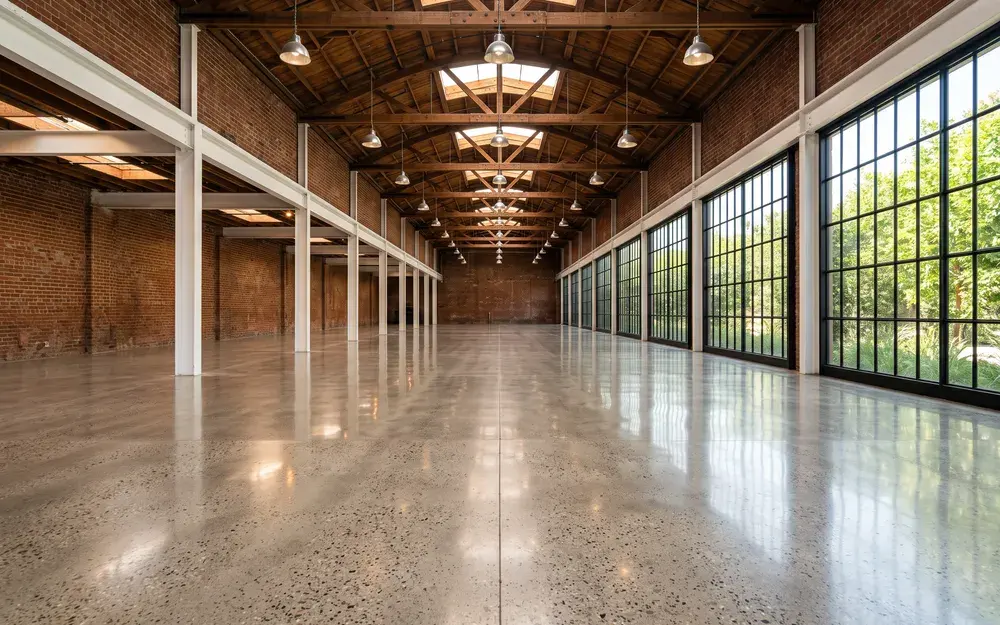
Polished concrete is a floor made from the slab you already have. Diamond tooling grinds the surface flat, a chemical densifier hardens it from the inside, and finer and finer grits bring up the sheen. Nothing is glued down and nothing is laid on top, so there is no covering to peel, curl or come loose later.
What is polished concrete?
It is a process, not a product. The slab is refined in stages until the surface is dense enough to reflect light and hard enough to shrug off traffic. Because the finish is the concrete itself, it does not delaminate the way a coating can, and a scuff is polished out rather than patched in.
How it looks depends on the slab. Grinding lightly leaves a smooth surface with the original cream finish. Going deeper opens the sand, and deeper again exposes the larger aggregate, which reads like terrazzo. We show you samples of all three on your own floor before we commit, because the same setting looks different on every pour.
How the grind and polish sequence works
We start coarse and finish fine. The first passes with metal bonded diamonds take out high spots, old glue and coatings, and flatten the slab. Then the densifier goes down and soaks in, hardening the surface so it can take a polish. After that come the resin bonded grits in order, each one removing the scratch pattern the last one left.
Skipping grits is the classic shortcut and it always shows. A floor jumped from a coarse grit to a fine one looks glossy under a work light and hazy under daylight, because the deep scratches are still there under the shine. The sequence is the job.
Where polished concrete works best
Warehouses, workshops, retail floors, offices, garages and open plan homes. Anywhere a slab already exists and a hard floor beats a soft one. It suits forklift and pallet traffic because there is no covering to gouge, and it suits showrooms because the light bounce makes a space read brighter without changing a single fitting.
It also suits owners who are tired of replacing flooring. A polished slab is maintained rather than replaced, and the maintenance is dust mopping and the occasional machine pass. For a commercial site that never wants a floor shutdown again, that is usually the whole argument.
Densifiers and sealers: what they do
The densifier is the part most people have never heard of and it is what makes the floor last. It reacts inside the concrete and hardens the surface, so the polish has something to bite. Without it a slab takes a shine and loses it, because the softness was never dealt with.
A guard or sealer goes on top afterward to help the floor shed spills while it is being cleaned up. It is not a coating and it is not armor. On a floor that sees oil, solvent or constant wheel traffic, an epoxy floor coating is often the better call, and we will say so.
Is polished concrete slippery?
Less than people expect, and less than a wet coated floor. A polished surface is smooth but it is not glazed, and the traction on a dry polished slab is comparable to other hard floors. Water is what changes the answer, exactly as it does on tile or sealed timber.
Where spills are routine, in a kitchen, a wash bay or an entry, we adjust the finish level or add a traction treatment rather than pretending the problem does not exist. That is a design decision made before the first pass, not a fix afterward.
What condition does the slab need to be in?
Sound and reasonably flat. Cracks can be filled and repaired first, and old adhesive, paint or coatings can be ground off. What cannot be fixed by polishing is a slab that is structurally failing, badly out of level over a long run, or so thin that the aggregate opens up before the surface is flat.
We check the slab before we quote. If the honest answer is that polishing will not give you the floor you are picturing, we say so up front rather than after the deposit. That check is free and it takes one visit.
Best Polished Concrete in Oakland
Oakland and the wider East Bay are full of older industrial and warehouse slabs being turned into shops, studios and offices, and those pours are exactly the ones that polish well once the old coverings come off. The same diamond tooling we use here is what takes a lip off a walkway on our trip hazard removal work.
Our floor work carries the same Lifetime Workmanship Warranty as our concrete outside. See everything we do on the concrete services hub, compare it against epoxy floor coating, or ask for a free assessment and we will grind a test patch on your own slab.
Why choose BA Sidewalk Restoration?
- Fully licensed and insured for your protection.
- Upfront pricing you approve before any work starts.
- Serving Oakland, San Francisco, Berkeley, San Leandro, Hayward, Fremont and surrounding areas.
Related services
- Epoxy Floor Coating, Resin floor coatings put down over a properly ground and repaired slab, for garages, workshops and warehouses that need a surface oil, wheels and hot tires cannot lift.
- Sidewalk Repair, Broken, sunken and lifted sidewalk panels cut out and poured back flat, with the permit filed and the cause of the damage dealt with so the new concrete stays level.
- Concrete Trip Hazard Removal, Lifted concrete edges taken down to a level, checkable surface by grinding, saw cutting or panel replacement, with the method chosen from the measured offset rather than from a price list.
Explore our full range of Concrete Services, or head back to the BA Sidewalk Restoration home page.
Cost of polished concrete in Oakland
What moves the price:
- Total square footage, since setup cost is spread across the floor
- What has to come off first: adhesive, paint, tile mortar or an old coating
- How far the grind goes, from a light cream polish to full aggregate exposure
- The gloss level you choose, because each extra grit is another full pass
- Slab repairs needed before polishing, such as crack filling and patching
Every job is different, so we give you an exact price up front, and you approve it before any work starts.
How it works
How our polished concrete process works
Get your free sidewalk assessment
Call or request a quote online. We'll take a look and give you an honest, upfront price, no pressure.
We schedule your job
Pick a time that works for you. We show up when we say we will and keep you in the loop the whole way.
Done right, the first time
Clean, quality concrete work, and we leave your property better than we found it.
Get a free sidewalk assessment for polished concrete
Call now or request a free sidewalk assessment, we'll get right back to you.
Licensed & insured · Lifetime Workmanship Warranty · No obligation
Find us
Oakland, CA area
FAQ
Polished Concrete, common questions
Where can I find polished concrete near me in Oakland?
BA Sidewalk Restoration polishes concrete floors across Oakland, CA and the nearby East Bay, under California contractor license CSLB #689821. We grind, densify and polish existing slabs for shops, warehouses, offices and homes. Our hours are 7:00 am to 5:00 pm Monday through Saturday. Call us and we will come out and test a patch of your slab.
Is polished concrete a better value than tile or vinyl over the life of the floor?
Usually, because there is nothing to replace. Tile grout, vinyl seams and glued coverings all wear out and get pulled up eventually. A polished slab is the building's own floor, so the long run cost is cleaning plus an occasional machine pass. The upfront number depends on your slab, and we quote it after we see what has to come off.
Who will be on site for my polished concrete job?
Owner Danny Williams runs the floor work. He has spent 31 years in concrete and flooring, and floors are a large part of that. You will not get one person quoting and a different crew arriving with different ideas about grit sequence. If we bring help for a large floor, the sequence and the standard are still his.
How long does polishing a concrete floor take?
A small floor with a clean slab is often a two or three day job. A larger floor, or one with old adhesive and coatings to remove, runs longer because that removal is its own stage before polishing starts. Densifier needs time to react as well. We give you a day count after we have seen the slab, not before.
Will polishing hide the cracks in my slab?
No, and anyone who says otherwise is selling. Polishing refines the surface, it does not close a crack. What we can do is repair and fill cracks first so they become a filled line rather than an open gap, and many owners like that the repaired line stays visible as part of the floor's character. Structural cracking is a different conversation.
How do I clean a polished concrete floor?
Dust mop for daily grit and a neutral pH cleaner with water for washing. Skip acidic cleaners and strong degreasers, which attack the surface you paid to harden. Grit left on the floor is the real enemy, because foot and wheel traffic grinds it in. On a busy commercial floor an auto scrubber on a regular schedule does the whole job.
Need polished concrete?
Call now or request a free sidewalk assessment, we'll get right back to you.
Licensed & insured · Lifetime Workmanship Warranty · No obligation