
Concrete Trip Hazard Removal
Lifted concrete edges taken down to a level, checkable surface by grinding, saw cutting or panel replacement, with the method chosen from the measured offset rather than from a price list.
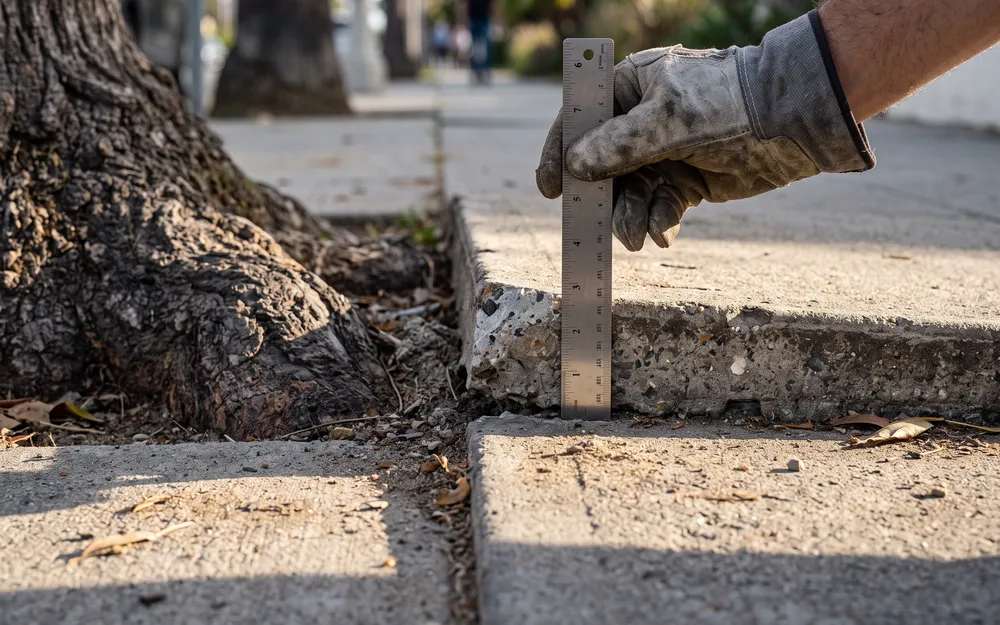
A concrete trip hazard is a vertical change in level between two slabs. Under the 2010 ADA Standards section 303, a change of up to 1/4 inch may be vertical, a change between 1/4 inch and 1/2 inch must be beveled at a slope no steeper than 1:2, and anything over 1/2 inch must be ramped. That measurement decides the fix.
What counts as a concrete trip hazard?
Height, not appearance. A hairline crack you can see from the porch may be harmless, while a quarter inch lip you cannot see from ten feet away is exactly what catches a toe. The number is what makes this trade checkable: an inspector, a claims adjuster and a contractor can all put the same ruler on the same edge and read the same answer.
Oakland uses that same threshold on residential frontage. The City states that any crack or vertical offset of more than 1/4 inch is considered a defect. So on an Oakland walkway there are two ways to fail: the lip and the crack. Clearing one and leaving the other still leaves a defect on the record.
Grinding: the fast fix for a small lip
Grinding takes the high edge down with a diamond wheel until the two slabs meet in a smooth ramp. It is quick, it makes no formwork, there is no cure time and the walk reopens the same day. On a sound panel with an offset up to roughly an inch, it is usually the right answer and the cheapest one.
Its limit is the concrete underneath. Grinding removes material, so a thin or already spalling slab cannot give up much before the aggregate opens up. We check slab thickness and condition before we commit to a grind, because a ground out crater is a worse surface than the lip we started with.
Saw cutting: when a section has to come out
Saw cutting is how a clean edge is made. We score the concrete on the joint line so the piece that has to leave comes out square and the piece that stays keeps a straight face. It also lets us take a narrow strip rather than a whole panel where a root or a settlement dip is confined to one edge.
The cut is also what protects the neighbouring slab. Breaking concrete out without cutting it first pulls a ragged spall into the panel you meant to keep, and that spall becomes next year's repair. This is the step that separates a tidy repair from an obvious one.
Panel replacement: when nothing else lasts
Replacement is the answer when the slab is cracked through, badly sunken, or lifted so far that grinding would eat the panel. It costs more and takes longer because there is demolition, base work, forms, a pour and cure time. What you get for it is a panel with a rebuilt base under it, which is the only version that survives a root that is still growing.
Replacement is often the honest recommendation even when it is not the answer the owner wanted. Full detail on that work is on our sidewalk repair page, and a single frontage often needs a mix of both methods.
Does grinding satisfy an Oakland compliance certificate?
It depends on what is left behind, not on the method. Oakland counts any crack or vertical offset of more than 1/4 inch as a defect. If the only problem is the lip and the concrete is sound, grinding it below that threshold removes the defect. If the panel is cracked through, the crack is a defect on its own and grinding the edge does not touch it.
Temporary patches are the other trap. A patch that fills a lip is a make safe measure, not a repair, and it moves with the slab it is stuck to. If your repair is tied to a sale, a permit file or a renovation, start with a sidewalk survey so the scope is set against the standard rather than against a guess.
Trip hazard removal for property managers and ADA routes
On a place of public accommodation the ADA framing is direct. An accessible route has to hold to the section 303 limits, and an offset that exceeds them is an access barrier as well as a claim risk. Property managers, HOA boards and commercial owners generally want the whole route measured at once rather than one complaint at a time.
We write those scopes so a board can read them. Every hazard is listed with its measured offset, the method we recommend, and why. That record is useful long after the concrete cures, because it shows the frontage was surveyed and acted on. You can read the standard itself on the United States Access Board site.
How do you decide which method a hazard needs?
We measure the offset at its highest point, check whether the slab is cracked, look at what caused the movement, and check how thick the concrete is. Small lip on sound concrete gets ground. Confined damage gets saw cut and partially replaced. A cracked or root lifted panel gets replaced. The measurement decides it, and we show you the number.
Best Concrete Trip Hazard Removal in Oakland
Oakland frontage calls for both methods, because the same block often carries a sound panel with a lip next to a slab a root has broken. We work the same way in San Leandro, where the City's Administrative Code treats the measured offset as the number that decides who pays. In Fremont the split turns on whether a tree caused the damage, and the City's 50-50 program is capped at $7,500 per property.
See how the rest of the work fits together on the concrete services hub, or read about polished concrete floors, which use the same grinders indoors. Call us or request a free sidewalk assessment and we will bring a ruler before we bring a quote.
Why choose BA Sidewalk Restoration?
- Fully licensed and insured for your protection.
- Upfront pricing you approve before any work starts.
- Serving Oakland, San Francisco, Berkeley, San Leandro, Hayward, Fremont and surrounding areas.
Related services
- Sidewalk Survey and Certification, A measured, written survey of your frontage against the standard the City applies, plus the repair work that clears it, for sales, renovation permits and property files.
- Polished Concrete, Existing concrete slabs ground and polished into a hard, low maintenance floor, with the densifier and the grit sequence chosen from what the slab is actually made of.
- Epoxy Floor Coating, Resin floor coatings put down over a properly ground and repaired slab, for garages, workshops and warehouses that need a surface oil, wheels and hot tires cannot lift.
Explore our full range of Concrete Services, or head back to the BA Sidewalk Restoration home page.
Cost of concrete trip hazard removal in Oakland
What moves the price:
- The measured vertical offset at its highest point, which decides grinding versus replacement
- How many separate hazards are in the scope and how far apart they sit
- Slab thickness and condition, because a thin or spalling panel cannot be ground far
- Whether the panel is cracked through as well as lifted, which rules grinding out
- Site access and traffic control on a busy commercial frontage
Every job is different, so we give you an exact price up front, and you approve it before any work starts.
How it works
How our concrete trip hazard removal process works
Get your free sidewalk assessment
Call or request a quote online. We'll take a look and give you an honest, upfront price, no pressure.
We schedule your job
Pick a time that works for you. We show up when we say we will and keep you in the loop the whole way.
Done right, the first time
Clean, quality concrete work, and we leave your property better than we found it.
Get a free sidewalk assessment for concrete trip hazard removal
Call now or request a free sidewalk assessment, we'll get right back to you.
Licensed & insured · Lifetime Workmanship Warranty · No obligation
Find us
Oakland, CA area
FAQ
Concrete Trip Hazard Removal, common questions
Where can I find concrete trip hazard removal near me in Oakland?
BA Sidewalk Restoration works out of Oakland, CA under California contractor license CSLB #689821. We grind, saw cut and replace concrete to remove trip hazards on sidewalks, walkways and accessible routes. Our hours are 7:00 am to 5:00 pm Monday through Saturday. Call us with the location and we will come out and measure it for free.
Is grinding cheaper than replacing the sidewalk panel?
Yes, usually by a wide margin, because there is no demolition, no base work, no forms and no concrete. The catch is that grinding only works on a sound slab with a modest lip. On a cracked or root lifted panel a grind buys a short reprieve and the lip returns. We measure first and tell you which of the two your panel actually needs.
How long does trip hazard grinding take?
A single lip usually takes well under an hour, and a run of several hazards on one frontage is normally a half day. There is no cure time, so the walkway reopens as soon as we sweep up. That is the real advantage of grinding on a busy commercial frontage where closing the path for days is not workable.
Are you insured and bonded to work in the public right of way?
Yes. BA Sidewalk Restoration is licensed, insured and bonded, and our California contractor license is CSLB #689821. Right of way work happens where the public walks, so that paperwork matters more here than on a back patio. We can send the details to your property manager or board before we start.
Does grinding leave the sidewalk looking patchy?
It leaves a lighter, smoother band where the wheel passed, and that band weathers back toward the color of the rest of the walk over time. It is a cosmetic difference, not a structural one. Where appearance matters, such as a storefront or a listed home, we can widen the ground area so the transition reads as deliberate rather than as a repair.
My tenant reported a trip hazard. What should I do first?
Photograph it with a ruler in the frame, note the date, and make it safe if you can. That record matters if a claim follows later. Then get the offset measured properly across the whole frontage, not just at the spot that was reported, because the one somebody noticed is rarely the only one. We do that walk and write it up.
Need concrete trip hazard removal?
Call now or request a free sidewalk assessment, we'll get right back to you.
Licensed & insured · Lifetime Workmanship Warranty · No obligation