How to Measure a Sidewalk Trip Hazard the Same Way an Inspector Does
A sidewalk trip hazard is measured by the vertical height at a joint or crack, not by how wide the gap looks. Lay a straightedge flat across the joint and read the tallest gap underneath it with a ruler. Under the 2010 ADA Standards section 303, a change up to 1/4 inch can stay vertical. From 1/4 inch to 1/2 inch, it must be beveled. Anything past 1/2 inch must be ramped. Oakland uses that same 1/4 inch line to call a frontage a defect.
What actually counts as a trip hazard measurement?
Height is what counts. Looks do not. A hairline crack can look bad from the porch and still be harmless. A quarter inch lip can be almost invisible and still catch a toe. This trade uses a number instead of a look for one reason: a number is checkable. An inspector, a claims adjuster, and a contractor can all put the same ruler on the same edge. They will all read the same answer.
A good measurement is more than just the height. Write down the largest offset. Note where it is and which way people walk there. Check if the ground nearby slopes. Note if the path is still safe to use. Skip the description "uneven sidewalk." Use a dated photo, the location, the measurement, and a short note instead. That gives anyone who looks at it next something real to act on.
How do you measure the vertical offset with a straightedge?
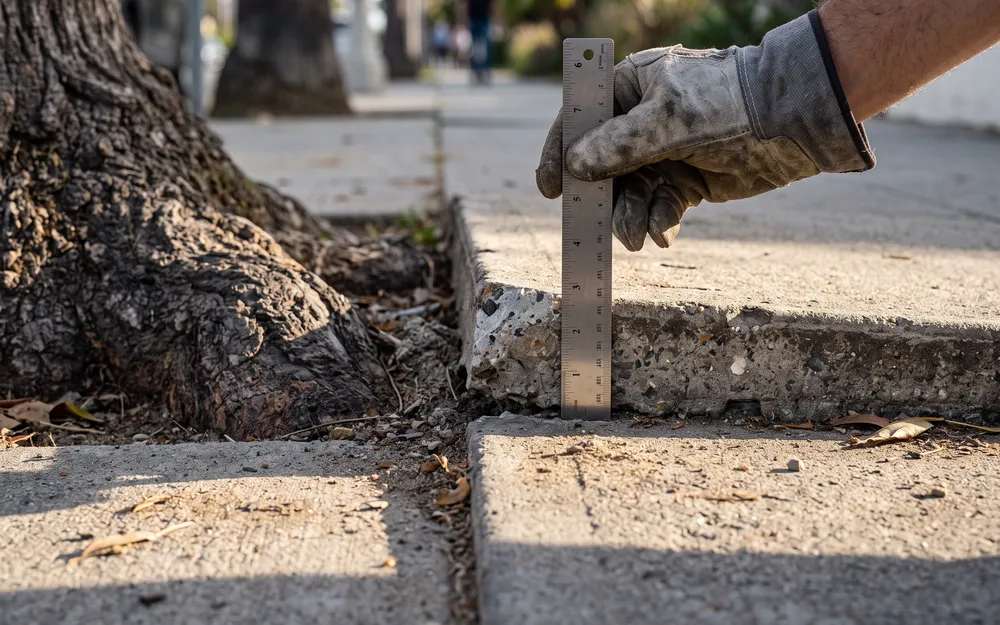
Lay a straightedge, a level, or a stiff board flat across the joint or crack. It should bridge both sides. If the ground is even on both sides, the straightedge sits flat. No gap. If one side has settled or lifted, a gap opens up under the straightedge on the low side. Slide a ruler into that gap at its deepest point. Read the height off the ruler. That number is the vertical offset. It is the number the ADA's tiers are built around.
Send us that number and a photo and ask for a free sidewalk assessment. We will tell you which repair method fits before anyone shows up with equipment.
What is the quarter test, and why is it not enough on its own?
Some sidewalk-repair sites describe a faster check. Stand a standard quarter up in the crack. If it stands, the gap is said to be near a 1/4 inch. It is a popular rule of thumb. It is quick, and it is worth knowing about. But it is not the real measurement.
Here is why. The quarter test checks how wide the crack's opening is. The ADA's line, and Oakland's line, are both about height, not width. A wide, shallow crack can pass the quarter test and still be flat enough to ignore. A narrow, tight joint can fail the quarter test and still hide a real step underneath. A straightedge and a ruler read the height directly. The quarter test only guesses at it.
What do the ADA's three measurement tiers mean for the fix?
The 2010 ADA Standards section 303 set three exact tiers. The number you measure decides which one applies. Section 303.2 lets a vertical change up to 1/4 inch stay vertical. No bevel needed. Section 303.3 requires a change between 1/4 inch and 1/2 inch to be beveled, at a slope no steeper than 1:2. Section 303.4 requires anything over 1/2 inch to be ramped instead.
The standard adds one more detail worth knowing. A full 1/2 inch change is allowed to be built as 1/4 inch vertical plus a 1/4 inch bevel stacked on top. That is why the same measured offset can call for a different fix depending on exactly where it lands. A quarter inch reading needs no work to meet the standard. A third of an inch needs a bevel. Three quarters of an inch needs a ramp. No exceptions.
Does Oakland use a different number than the ADA?
No. Oakland states, in its own words, that any crack or vertical offset of more than 1/4 inch is a defect, under the Federal Americans with Disabilities Act Guidelines. The City uses the same 1/4 inch line the ADA sets. It is not a separate local number.
Here is what that means for an Oakland homeowner. The same straightedge reading an inspector, a claims adjuster, and a contractor would use is the same reading the City checks against. There is no separate Oakland ruler to learn. There is one number, and you already know it.
When does a self-measurement need to become a written survey?
A self-measurement is a first step. It tells you roughly where you stand. It tells you if the number is close to a tier boundary. It is not the record Oakland asks for on a sale, a purchase, or a renovation valued at more than $100,000. For those, the City requires a sidewalk compliance certificate. Oakland created it through Ordinance No. 13549 in 2019, added to the Municipal Code as section 12.04.380. The City issues the certificate, not a contractor. But a contractor can measure the whole frontage against that standard, fix what fails, and hand over a written record of both.
That written version is a written sidewalk survey. Every hazard on the frontage gets listed with its measured offset and the method it needs, not one panel at a time. Owner Danny Williams has worked in concrete and flooring for 31 years and does the measuring himself. He opened BA Sidewalk Restoration in 2026. The repair work carries a Lifetime Workmanship Warranty. Once you know the offset, the fix is one of three methods: grinding, saw cutting, or full panel replacement.
A measured offset can change who pays the bill, too. If the timeline started with a City letter, see what a Notice to Repair means for your timeline. If a root is involved, see whether a tree caused the lift and who pays for it. Once you know the scope, what a sidewalk repair permit costs across the Bay Area covers what comes after the measuring is done.
Get your straightedge reading and call (510) 314-9236. The ruler comes out before the quote does.
Talk to BA Sidewalk Restoration
Questions about your concrete job? We serve Oakland and the surrounding area with honest, upfront advice.
Get a Free Sidewalk Assessment
Related articles
FAQ
Related questions
How do you measure a trip hazard with a quarter or coin?
Some sidewalk-repair sites describe standing a quarter up in the crack. If it stands, the gap is said to be near a 1/4 inch. That is a rough first pass, not a real measurement, because it checks how wide the gap is, not how tall the vertical step is. A straightedge laid flat across the joint, with a ruler measuring the gap underneath it, reads the actual height.
What is the ADA 1/4 inch trip hazard rule?
The 2010 ADA Standards, section 303, set three tiers by height. A vertical change up to 1/4 inch can stay vertical, with no bevel required. Between 1/4 inch and 1/2 inch, the change must be beveled at a slope no steeper than 1:2. Anything over 1/2 inch must be ramped.
When does a sidewalk lip need a bevel instead of a ramp?
A bevel is required once the vertical change passes 1/4 inch, and it stays a bevel option up to 1/2 inch, sloped no steeper than 1:2. Past 1/2 inch, section 303 no longer allows a bevel. The fix has to be a ramp instead.